
Introduction
Global trade has always been about movement, the movement of commodities, products, capital, information, and opportunity across borders. What is changing today is the intelligence surrounding that movement. Digital platforms, connected systems, automation, and artificial intelligence are creating a new commercial environment in which physical trade and digital capability are becoming increasingly intertwined. For businesses operating internationally, understanding this convergence is becoming an important part of navigating a faster, more connected, and increasingly information-driven global economy.
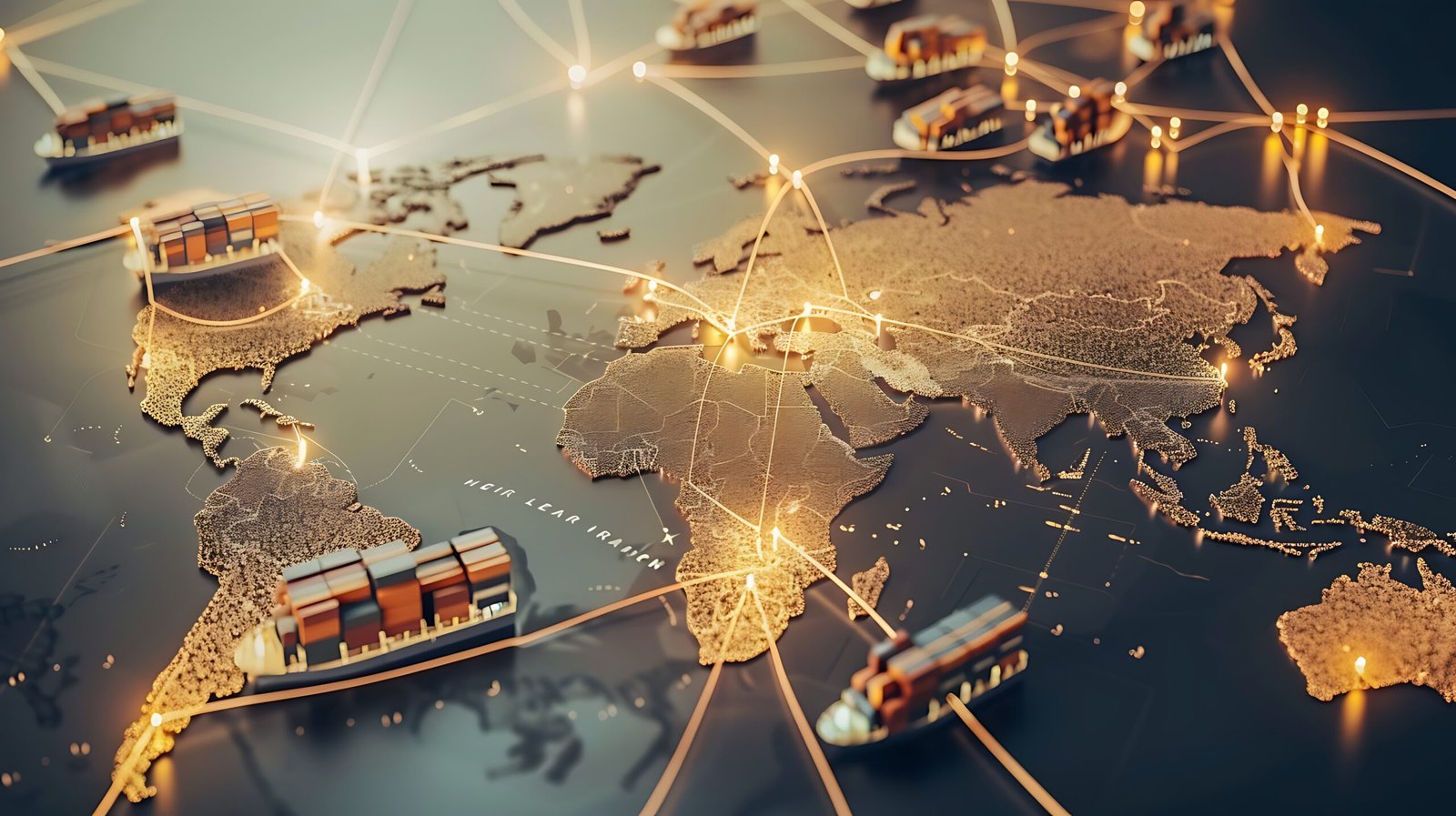
Commerce in a Connected World
International commerce is entering a period of significant transformation. For generations, the fundamentals of trade have remained relatively consistent: businesses identify opportunities, establish commercial relationships, exchange information, coordinate transactions, and move value between markets. These fundamentals continue to define global business, but the environment surrounding them has changed dramatically. Information now moves almost instantly, businesses operate across multiple jurisdictions, market developments can influence decisions within hours, and organizations increasingly rely on digital infrastructure to coordinate activities that were once managed manually.
This evolution has created a commercial landscape in which connectivity itself has become a strategic capability. Businesses are expected to communicate efficiently, access relevant information quickly, maintain organized documentation, and respond to changing circumstances with greater speed. As international operations become more complex, fragmented processes can create delays and reduce visibility. The ability to connect information, people, and processes therefore becomes increasingly important. Global commerce is no longer shaped solely by the ability to move physical value; it is also shaped by how effectively organizations manage the information surrounding that movement.

Beyond the Physical Transaction
A commercial transaction may ultimately involve the exchange of a physical product or asset, but the transaction itself is supported by a much broader information ecosystem. Requirements must be communicated clearly, commercial terms need to be understood, documentation must be coordinated, operational information needs to reach the appropriate parties, and decisions often depend on information arriving accurately and at the right time. The larger and more international the transaction environment becomes, the more important this invisible layer of commercial activity becomes.
This means that information management is increasingly becoming part of commercial capability. Businesses that rely heavily on disconnected spreadsheets, email chains, separate databases, and manually maintained documents may find it more difficult to develop a complete view of their activities. When information is fragmented, teams can spend valuable time searching for updates, verifying details, and repeating administrative work. Digital transformation offers an opportunity to create more structured environments where information can be accessed, organized, and communicated more effectively. The objective is not simply to make traditional processes digital, but to create greater clarity around how commercial activity progresses.
The Digital Layer of Global Commerce
-
Software has gradually become part of the infrastructure of international business. Enterprise platforms, cloud applications, digital documentation systems, workflow tools, and integrated communication environments are helping organizations manage increasingly complex operations. Processes that once required extensive manual coordination can now be structured through digital workflows, while information from different activities can be consolidated into systems that provide decision-makers with greater visibility.
-
The next stage of this evolution is integration. Many businesses already use multiple digital systems, but those systems do not always communicate effectively with one another. Information may exist across financial platforms, customer systems, operational applications, documents, and external data sources. When these environments become better connected, businesses can reduce unnecessary duplication and create more coherent workflows. A change recorded in one system can inform another process, relevant information can move automatically between applications, and teams can spend less time manually transferring data. The value of digital technology therefore increasingly comes not from individual applications, but from the ecosystem created when those applications work together.
-
Intelligence Enters the Equation
Artificial intelligence introduces a new dimension to this digital environment because it expands what software can potentially do with information. Conventional business systems are generally effective at storing structured data and executing predefined processes. AI-enabled technologies can increasingly work with less structured information such as documents, written communication, large knowledge bases, and complex datasets. They can assist with summarization, classification, research, information retrieval, pattern recognition, and other activities that traditionally required significant manual effort.
-
For global businesses, this could influence how organizations interact with commercial information. Teams may be able to navigate large document collections more efficiently, identify relevant information faster, generate preliminary analysis, or access organizational knowledge through more intuitive interfaces. However, the value of these technologies depends on how thoughtfully they are applied. Introducing artificial intelligence into an inefficient process does not automatically make that process intelligent. Businesses first need to understand what they are trying to improve, what information is available, where human judgment is necessary, and what measurable value technology is expected to create.
-
From Digitization to Intelligent Coordination
The first phase of digital transformation was largely about converting physical activities into digital ones. Paper documents became electronic files, manual records moved into databases, meetings moved online, and locally installed software increasingly shifted toward cloud platforms. These changes created enormous efficiencies, but they often preserved the structure of the processes that existed before them. A manual workflow with ten stages frequently became a digital workflow with the same ten stages.
-
The emerging opportunity is to reconsider those processes altogether. Connected systems, automation, and intelligent technologies allow businesses to ask whether information can move more efficiently, whether repetitive activities can be reduced, and whether decision-makers can receive the information they need without manually assembling it. This represents a transition from digitization toward intelligent coordination. Rather than simply using technology to perform the same activities faster, organizations can redesign how different activities connect. The result can be a more responsive environment in which technology supports the movement of information while people concentrate on decisions, relationships, and commercially significant activities.
Where Physical Value Meets Digital Intelligence
The global economy will continue to depend on physical value. Resources will be produced, products will be manufactured, infrastructure will develop, goods will move between markets, and businesses will continue to create commercial relationships across borders. None of these fundamentals are disappearing. What is changing is the increasingly sophisticated digital environment surrounding them.
Software will organize more of the processes. Data will provide greater visibility. Automation will manage more repetitive activity. Artificial intelligence will help businesses interact with information in new ways. Human expertise will remain responsible for understanding context, building relationships, evaluating opportunities, and making consequential decisions. Together, these elements are creating a new architecture for global commerce in which the physical and digital economies are no longer separate worlds.
At Certus Global, this convergence reflects a broader view of how modern business is evolving. Established commercial sectors and emerging technologies increasingly influence one another, creating possibilities that cannot always be understood through a single-industry perspective. The organizations prepared for the future will be those capable of seeing these connections and understanding how different forms of value interact.
The next chapter of global commerce will not be defined by physical trade or digital intelligence alone. It will be shaped by how effectively the two are brought together, connecting markets, information, technology, and human expertise to create smarter pathways for global value.